QA Outsourcing in 2026: How It Works, What It Costs, and How to Choose a Partner
QA outsourcing means paying an outside team to plan, run, and report on your software testing, either as a managed service that owns the QA outcome or as extra testers who work under your lead. In the US, one in-house QA engineer has a fully burdened cost (salary plus benefits) of about $149,000 a year, and we look closer at those expenses in the cost section below. The higher cost is usually a miss: a slipped migration, a failed audit, or a user who can’t get to their medication because a release broke the flow.
Outsourcing tends to pay off when you have a clear idea of the problem you’re solving, you pick a partner and a model that fit that goal, and you’re willing to invest time to make the partnership work. An engaged leader and a deadline both help, because they add context and keep the work focused.
Why Are More Teams Outsourcing QA in 2026?
Code volume has gone up, but the capacity to verify it hasn’t. This gap shows up in AI adoption data and delayed release dates, which drive many QA outsourcing decisions.
The National Ratio Is About Nine Developers per Tester
The US Bureau of Labor Statistics counts 1,717,800 software developers and 187,600 QA analysts and testers for 2025. Divide one by the other, and you get 9.2 developers for every tester in the country.
That ratio matches what we’re hearing: one tester, nine developers, and a manual regression pass that takes up the whole week before each release. In our experience, a healthy ratio is one QA engineer for every three developers, though this varies with team needs, how much of the testing is automated, and how AI-enabled the development process is (AI enablement calls for stronger QA). At 9.2 to one, the national average gets about a third of that coverage.
Closing that gap takes more verification capacity, and that comes from strategy, test design, and the right mix of manual and automated testing as much as from headcount.
AI-Written Code Raised Volume Faster Than Teams Can Check It
Developers adopted AI coding tools quickly, and the latest data shows checking hasn’t kept up. In Sonar’s 2026 State of Code survey of 1,100+ developers, AI accounts for 42% of committed code, 96% of developers don’t fully trust that AI-generated code is functionally correct, and only 48% say they always check AI-assisted code before committing it.
Testing teams feel it too. In mabl’s 2026 State of Quality Engineering Report, teams spend an average of 20% of their working week manually verifying AI-generated tests and code. Almost-right code passes a quick sanity check and fails on the edge case a customer hits first.
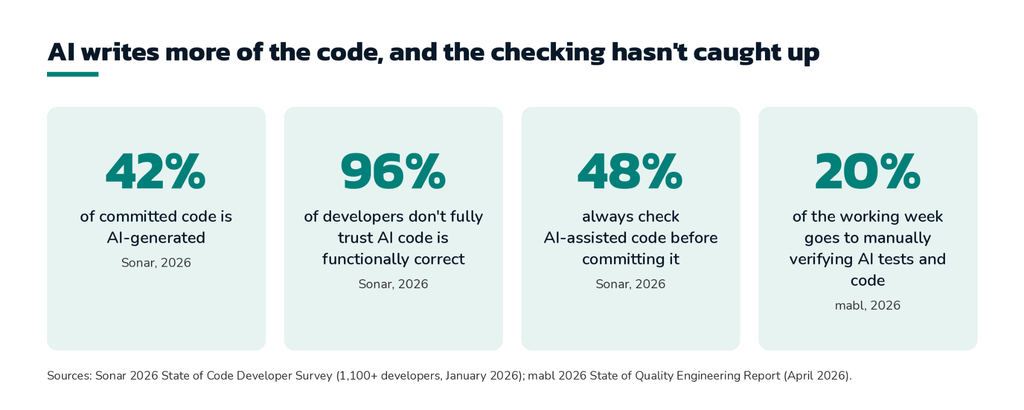
AWS CTO Werner Vogels has called the result verification debt: code ships faster than anyone can confirm it does what it should. Our post on why AI’s speed creates verification debt, and the list of top 10 AI coding quality risks, go deeper on both.
A Date You Can’t Move Usually Starts the Search
In customer conversations, the search for software testing outsourcing usually starts with a fixed date:
- A launch or go-live a few weeks out, with no tester on the team
- A platform migration where business users run UAT and nobody can tell what they covered
- An audit that needs test evidence, traceable back to requirements
- A traffic spike, such as a campaign or a launch day expected to bring many times the normal load
Timing is one factor in the build-or-buy decision, alongside a few others. If you’re reading this with a deadline in mind, the section on how an engagement typically runs is the one to read closely.
Why Teams Outsource Instead of Building In-House
Teams usually build QA in-house when it’s strategic to what they do, when they want more control, or when they’re ready to make a serious long-term investment in an internal capability.
Outsourcing makes sense when you want quick access to capabilities that wouldn’t pay off to build or maintain yourself. In our experience, those include:
- A Seasoned QA Leader: someone with 20 years in QA can cost $300,000 a year in-house, while a partner gives you part of that person’s time
- Device Libraries and Test Infrastructure: often tens of thousands of dollars to build and keep current
- Technology Accelerators: tools and frameworks a specialist provider has already built and proven
Outsourcing can cost more per head, and it shifts the risk of building a capability that might not work out to the partner. It’s often more cost-effective once you count the capabilities it brings, which is why picking the right partner makes such a difference.
How Does QA Outsourcing Work?
Every outsourced QA arrangement answers two questions: who directs the testers, and who’s accountable when a defect escapes. The engagement model you pick sets both, so it’s the first decision to get right.
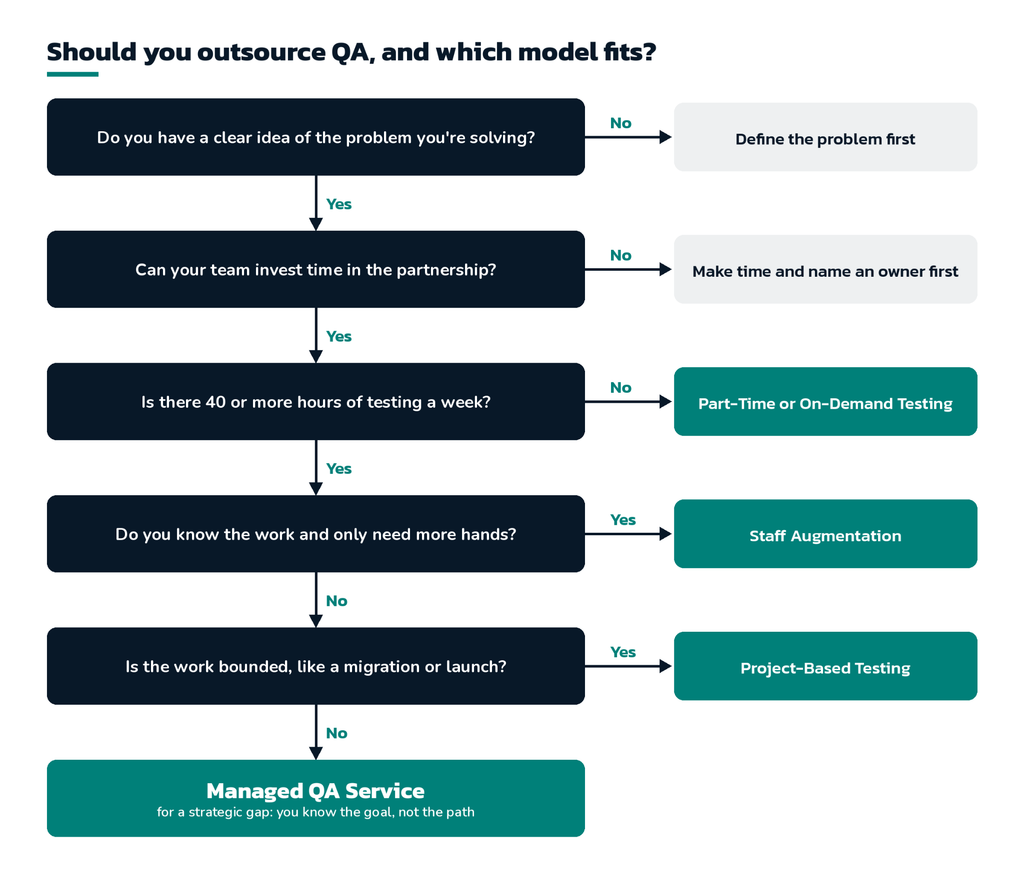
The Five Engagement Models and What Each One Buys You
| Model | Who Directs the Testers | Who Owns the Quality Outcome | Fits Best When | Limitations |
| Managed QA Service | The partner’s QA lead and manager | The partner, against agreed scope | You need a partner to fill a strategic gap: you know the problem and the goal, but not how to get there | Only as strong as the partner’s strategic depth and domain expertise |
| Staff Augmentation | Your QA lead | You | You know the work and the process, and need more hands | You take on training, backfill, and day-to-day management |
| Project-Based Testing | The partner, for a fixed scope | The partner, until the project ends | Bounded, well-understood work such as a migration, launch, load test, or accessibility audit | Coverage stops when the project does |
| On-Demand Testing | You | You | Less than 40 hours a week of testing, or work that comes and goes | Typically more expensive hourly |
| Crowdtesting | You | You | Testing at scale across geographies, hard-to-replicate workflows such as KYC or payments, localization, or usability across demographics | Little domain knowledge, and a high volume of results to triage |
The major difference between the first two is where most buyers get stuck. Staff augmentation sells you people. A managed service sells you a result, with someone on the partner side whose job is the quality of the testing itself. Our breakdown of QA staff augmentation vs QA managed services covers contracts and billing for each.
If your team cares more about the outcome and the strategy than about adding people, that’s a sign a managed service fits. If you need less than 40 hours of testing a week, a full-time dedicated team is more than you need, and a good partner will tell you so on the first call, even when the right answer is a different kind of engagement. For part-time and on-demand work, an organization like Mindful QA may be a better fit, given its specialization in flexible, on-demand testing for teams that need fewer hours or have an irregular schedule.
Who Does What Inside a QualityLogic Managed QA Team?
Here’s how QualityLogic structures a managed team:
- A QA Manager who is your single point of contact and owns the test strategy, scope, escalations, staffing, budget, and the team’s performance, and who is accountable for outcomes
- A QA Lead who runs the day-to-day work, unblocks the team, builds product knowledge, cross-trains testers, and reports progress. The lead also catches what literal test execution misses (the checkout that asks for a credit card on a $0 copay, for example). On automation programs, a senior QA engineer or engineering manager usually fills this role.
- Testers and QA Engineers who write and run tests, log defects, and maintain the suite
Our teams work inside your process: joining your stand-ups, filing defects in your defect tracker, and talking in whatever chat tool your team uses. Our methodology adds daily reporting, a monthly budget report, and a quarterly business review, and every test and defect traces back to the story it covers.
What Changes When Testers Are Onshore, Nearshore, Offshore, or Hybrid?
Location decides two things: how many working hours overlap with your developers, and where your data goes. A tester eight time zones away finds a blocking defect at their 10 a.m. and waits until your next morning for an answer, so a one-hour question becomes a one-day delay.
From a US buyer’s point of view, the options usually compare like this:
- Onshore: the highest cost, with your time zone and working hours
- Nearshore: lower cost, with time zones close to yours
- Offshore: the lowest cost, with little or no time zone overlap
- Hybrid: a US-based manager leading an offshore team. You get a single point of contact in your time zone, but it adds a middle layer of communication and leaves the collaboration risk at the team level in place.
The complexity of your product and testing program weighs as much as cost. Complex products benefit from real-time collaboration and a team embedded in your process, which gets harder across time zones and can lead to miscommunication, delays, and quality issues. Time-sensitive testing needs the same kind of team, one that can respond during your working day.
Managing a nearshore or offshore team is also a skill of its own. Leaders who do it well often have prior experience running offshore delivery centers, and they travel to those centers to build the team and its culture. Without that experience, offshoring is much harder to make work.
Data is the harder constraint. In healthcare, fintech, and anything touching PHI, US-only testing is often required before price. We’re a 100% US-based QA firm with 100+ employees across 20+ states, SOC 2 Type 2 compliant, with no data leaving the country. For the full trade-off, see our onshore vs offshore QA testing guide and our healthcare software testing and fintech testing pages.
What Happens When a Test Fails?
This is where outsourced QA either saves time or wastes it. A failed test has four possible causes: a real defect, a broken test, bad test data, or an unstable environment. The partner should triage which one it is before anything reaches a developer.
Test maintenance and test data slow many teams down. In a Leapwork survey of 302 QA professionals fielded in early 2026, 56% named test maintenance as a top slowdown, and about 40% said test data control slows their team down. Shared test accounts that anyone can change are a common culprit. Ask any partner how they isolate test data, and read our guide to avoiding test rot and flaky suites for what good maintenance looks like.
What Does QA Outsourcing Cost in 2026?
You can’t judge a QA testing outsourcing quote without knowing what the in-house alternative costs, so start there.
The In-House Baseline: About $149,000 for One QA Engineer
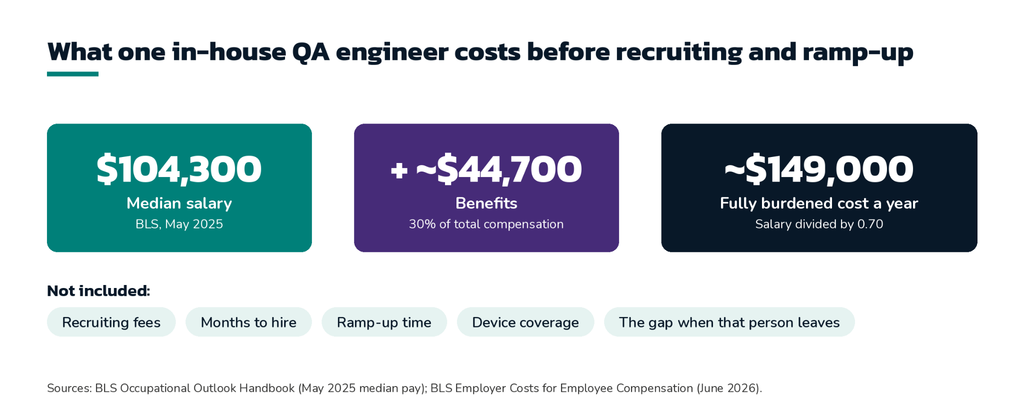
BLS puts the median wage for software QA analysts and testers at $104,300 (May 2025). Benefits make up 30.0% of total compensation for private industry workers (June 2026). That puts the fully burdened cost of one median QA engineer at about $149,000 a year (salary divided by 0.70), which includes about $44,700 in benefits.
That’s before recruiting fees, the months it takes to hire, ramp-up time, device coverage, and the gap when that person leaves. It also buys one person, with one person’s skills and one person’s vacation calendar.
A managed QA contract can cost less than that hire, about the same, or more, depending on how it’s set up and where the team is located. For comparable US-based coverage, QualityLogic engagements typically run $100,000 to $200,000 a year. With us, that budget buys a seasoned QA leader who sets strategy, a dedicated QA team, and the test labs, device coverage, tools, and accelerators a specialist provider brings, scaled to what you need and accountable for the outcome.
The more useful comparison is the cost of a miss. A new hire comes with ramp-up time and the risk of hiring the wrong person. A miss can mean a delayed or failed migration, a compliance audit that ends in fines, or a user who can’t get to their medication. Providers are built to absorb different levels of that risk, depending on the model and on who the provider is. A staff augmentation firm supplies people, and a low-cost provider, even one running a managed service, may use a lightweight model without the domain expertise to reduce risk.
QualityLogic is built for the other end of that range: work that has to be correct, where the cost of a miss far exceeds the cost of a full-time hire. Teams call QualityLogic when a mistake could mean a lawsuit or severe business impact.
The Four Pricing Models and What Each One Charges For
- Fixed Monthly Fee: a set price for a defined scope, common for managed QA. Predictable for budgeting, but scope changes need a conversation.
- Time and Materials: an hourly or weekly rate per person. You pay for hours worked, which suits work that changes week to week. Ask for weekly reports tied to output, so you can see what the hours produced.
- Build Fee Plus Monthly Maintenance: common for test automation. You pay once to build the suite, then a flat fee to run and maintain it.
- Fixed-Price Project: one price for a defined deliverable, such as a load test before launch or an accessibility audit.
With most providers, one of the first questions buyers ask is “Is it people times rate?”, and the answer is usually yes. The rate depends on seniority and the mix of manual testers and automation engineers.
QualityLogic’s default approach is to start with the problem you’re solving and the outcome you need, then price the engagement as a fixed fee to achieve that outcome, with QualityLogic accountable for delivery. This removes the risk of paying for a service that never meets your goals.
Costs to Check Beyond Any Partner’s Quote
With any partner, a few costs sit outside the quote. Ask about each one before you sign:
- Your Team’s Time: accounts, access, documentation, and answering questions while the team learns the product
- Tooling: device clouds, test management tools, and CI minutes, if the partner doesn’t bring them
- Test Environments and Data: often the slowest blocker to fix
- Exit Cost: if the partner keeps the test code, you rebuild it when you leave, so make sure everything lives in your repo
QualityLogic’s approach reduces most of these. Its teams work from whatever documentation you have, bring their own test labs and device coverage, and help set up test data when you don’t have it. Every test script and artifact QualityLogic builds is delivered to your repository so you own it outright.
To see what that looks like for your product, request a quote, and we’ll scope it around the outcome you need. For more on budgeting, see What should quality cost? and 8 ways to get more from your QA budget.
When Is QA Outsourcing the Wrong Call?
Outsourcing tends to pay off with three ingredients: a clear idea of the problem you’re solving, a partner and model that fit that goal, and the time to make the partnership work. When the first or the last is missing, your money usually goes further somewhere else first, and a deadline helps keep the work efficient. Choosing the right partner and model is covered in the next section.
There’s No Clear Problem to Solve
If better QA is a nice-to-have rather than the answer to a specific problem, such as defects reaching production, a migration, a modernization project, or a compliance audit, it’s hard to know what success looks like or when you’ve reached it. Write down the problem and the outcome you want first.
Nobody Has Time to Invest in the Partnership
An outsourced team needs someone on your side who sets priorities, answers “is this a bug or a feature?”, and accepts the results. Without that time, testers guess, and work gets thrown over the fence in both directions. An engaged leader makes this easier, because they streamline decisions and add context the team can’t get any other way.
A Deadline Keeps the Work Efficient
A time-bound goal tends to make the work more efficient. Without a clear goal and a date to meet it, it’s easy to go through the motions, which wastes resources and focus.
How Do You Choose a QA Outsourcing Partner?
You’ll know a lot from the first call. A partner that asks about your release cadence, your tester-to-developer ratio, and your CI pipeline is already doing the job. One that opens with a capabilities deck isn’t.
Ten Questions to Ask Before You Sign
- Who leads our work, and how many years have they spent in QA?
- How soon can someone start, and what do you need from us before day one?
- Will your people join our stand-ups and work in our tools?
- Where are the testers located, and where does our data go?
- Who owns the test code and test cases when we part ways?
- What does a weekly report look like? Can we see a real one with names removed?
- When a test fails, who triages it, and how fast do we hear?
- Can we get the same people back for the next project?
- What does signing commit us to: minimum hours, term, notice period?
- How do you use AI in testing, and who checks what the AI produces?
Red Flags in the First Conversation
- No questions about your product, your users, or your release process
- A long assessment or detailed proposal that isn’t grounded in anything you discussed on the call
- A coverage percentage promised before they’ve seen your app
- No case study or reference in your industry
- Junior testers proposed for a complex, regulated system without a senior lead
When a Specific Partner Isn’t the Right Fit
Sometimes outsourcing is the right call and a particular partner is the wrong one. Check for these three situations:
- You Need Hands-On Access They Can’t Get: some testing needs physical hardware, a specific carrier network, or industrial control systems that can’t be shipped or simulated. Ask whether the partner has done that exact kind of testing, and keep looking if they can’t name a project.
- You Need Strategy, and They’re Offering Headcount: a staffing firm can supply someone with good judgment, but screening and selecting that person is on you. If you’re not a QA expert yourself and need a partner’s expertise and strategy, a staffing firm leaves you on your own, because assessing and managing quality is the gap you’re trying to fill. Hire a managed service partner for strategy, and a staffing partner for extra hands.
- Your Data Has to Stay in the Country, and Their Team Is Offshore: This is often a deal-breaker in healthcare and parts of finance, so check where every tester sits and where test data is stored before you look at price.
Proof Worth Asking For
Ask any QA outsourcing services provider for case studies with numbers, in your vertical if possible. Here’s what QualityLogic’s look like:
- A community monetization platform that started with zero internal QA now runs about 3,000 end-to-end tests in its Jenkins pipeline (QA transformation case study)
- A retail POS provider had 18,000+ lines of Protractor tests converted to Playwright in 15 hours, against an estimated 460 hours by hand (Playwright migration case study)
- A messaging-adjacent app was load tested for up to 30,000 concurrent users before launch. A 1% timeout rate was found and fixed, and launch day had 0% request failures (app launch case study)
How an Outsourced QA Engagement Typically Runs
A good engagement starts small and expands on evidence: crawl, walk, run. Drop five testers on a team in week one, and you create a new bottleneck. One of our healthcare clients, for example, started with iOS only, the latest OS versions, and core flows, on the logic that if the core app doesn’t work, the rest of the test plan can wait. The phases below are typical, and timing stretches for complex products and workflows.
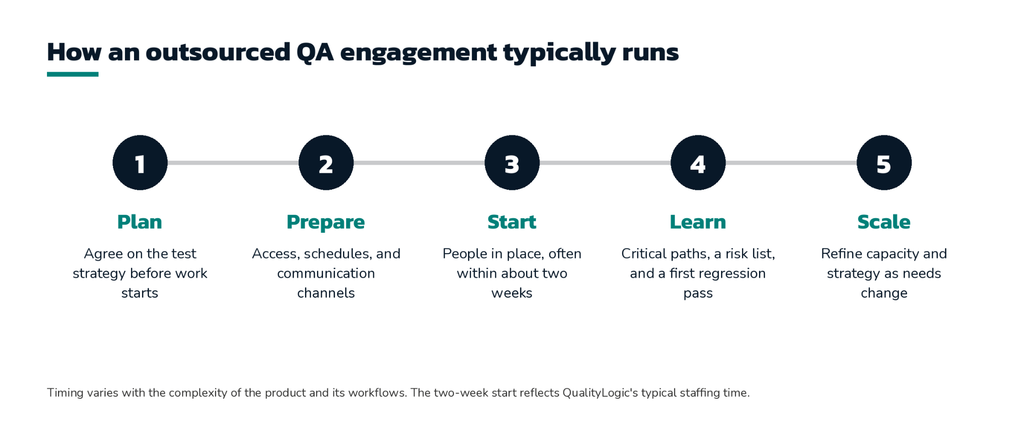
Plan: Agree on the Test Strategy First
The test strategy comes before the engagement starts, so the team arrives with a plan. It depends on what you’re trying to achieve and where you’re starting. For example, test automation is sustainable when its preconditions are in place: a stable test environment, the ability to set test state, test cases with clear acceptance criteria, and unique identifiers or a resilient locator strategy.
The return has to be there too. If an app will be retired in six months, a large automation investment rarely makes sense, even though AI has made automation cheaper to build. Our guide to getting the right mix of automated and manual testing covers how to choose.
Prepare: Access, Schedules, Communication Channels
Before day one, these help if you can set them up:
- Test accounts with the right permissions, one per team member where possible, or shared accounts if that’s how your team works
- Whatever access your security rules allow, such as your repo, CI, defect tracker, and a shared chat channel. QualityLogic works within each client’s requirements.
- Whatever documentation exists, even if it’s thin or out of date. Our teams are used to working from thin or missing documentation.
- Test data that won’t collide with anyone else’s. If you don’t have it, we can help set it up, and when production data must be used, it needs tight security controls.
Start: People in Place Within About Two Weeks
Most partners need some lead time to assign people. We usually have people in place within about two weeks of signature, depending on who’s available. Those two weeks cover getting the right people assigned, and learning your product comes after.
Learn: Map the Product, Test What Can’t Break
The partner’s team joins stand-ups, maps the critical paths, and writes a short risk list. Early on, you should see a first regression pass on those paths, with defects in your tracker and clear repro steps. How soon depends on the complexity of the product.
Scale: Refine Capacity as Needs Change
Once the first weekly reports and early findings are in, you decide whether to scale up, hold, or scale down, then keep refining capacity and strategy as your needs change.
Have a launch or migration date coming? Talk to QualityLogic’s managed QA team about getting your critical paths tested before it arrives.
How Is AI Changing QA Outsourcing Services?
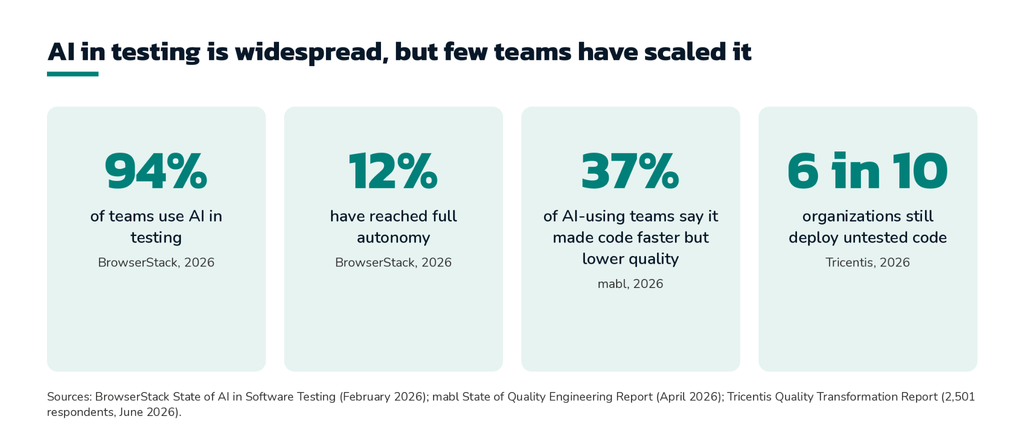
Teams are adding AI to testing quickly, but few have scaled it. In BrowserStack’s 2026 State of AI in Software Testing report, 94% of teams use AI in testing, but only 12% have reached full autonomy. Results are mixed too. Among teams using AI in mabl’s 2026 report, 41% say it improved code quality, while 37% say it produced code faster but at lower quality.
Meanwhile, a testing gap remains. In Tricentis’s 2026 Quality Transformation Report, six in 10 organizations still deploy untested code, and 30% point to the volume of AI-generated code as too overwhelming for teams to test fully.
For a buyer, AI can speed up test planning and test writing, and a partner should be able to show you where it does. AI-generated tests still need a QA engineer to confirm they check the right thing, because a test that only confirms how the application behaves today locks in any wrong behavior instead of testing it.
That’s also why adversarial testing helps: using a different model to write the tests than the one that wrote the code, because models of the same kind tend to share the same blind spots. QualityLogic covers AI test planning in How good is AI at test planning? Ask every partner who reviews the AI’s output, and how they’d know if it was wrong.
Where to Start If You’re Weighing QA Outsourcing This Quarter
With AI writing more of the code, the most valuable thing a QA partner brings is critical thinking and strategy. A QA team following a basic playbook can make problems worse, while a strategic partner works to understand your product, your goals, and your organization, then recommends the right strategy and works through it with you.
Write down the problem you need to solve and the product area that would hurt most if it broke. That’s where testing should start. Then talk to two or three partners and see which one asks better questions about it.
We have been running QA programs since 1986, with US-based QA experts, tests that live in your repo, and engagements priced around the outcome you need. If you want a straight answer on whether software testing outsourcing fits your situation, including when it doesn’t, book a discovery call.
Frequently Asked Questions
What Is QA Outsourcing?
QA outsourcing is hiring an outside company to handle some or all of your software testing. It can be a managed service that owns QA outcomes, testers who work under your QA lead (staff augmentation), or a fixed project such as a pre-launch load test. The partner brings the people, process, and often the tooling.
Is Outsourced QA Cheaper Than Hiring In-House?
When considering total cost of ownership or the impact of adopting the correct QA strategy, oftentimes yes. One median US QA engineer costs about $149,000 a year with benefits, before recruiting and ramp-up. A managed QA contract can cost less, about the same, or more, depending on its setup and team location. Outsourcing tends to be more cost-effective once you count the capabilities you’d rarely build in-house, such as a seasoned QA leader, device libraries, and test infrastructure, plus the cost of a miss it helps you avoid.
How Long Does It Take an Outsourced QA Team to Start Contributing?
QualityLogic can usually have people in place within about two weeks of signature, depending on availability. How fast they contribute after that depends on the complexity of your product and workflows. QualityLogic usually runs a first regression pass on critical paths early in the engagement, even with limited documentation.
Should Developers Test Their Own Code Instead of Outsourcing QA?
Developers should write unit tests and sanity-check their work, but testing is its own discipline. Developers specialize in making things work, and testers specialize in breaking them, with different techniques and tools. Adding testing to developers’ jobs also pulls them away from building and can lead to burnout.
Leaving bugs for customers to find adds risk too: reputational damage, a poor user experience, and disengagement, and in regulated software, possible fines and noncompliance.
Is Staff Augmentation the Same as QA Outsourcing?
It’s one form of it. With staff augmentation, you direct the testers and own the results. With a managed QA service, the partner’s lead directs the work and is accountable for its quality. If you don’t have a strong QA lead, a managed service is the safer choice.
Can We Outsource QA If We Handle PHI or Financial Data?
Yes, if the partner’s testers and data stay where your compliance rules require. Ask where every tester sits, whether real customer data will touch test environments, and for proof of controls such as SOC 2 Type 2.
Do We Own the Automated Tests a QA Partner Builds?
You should. Insist that test code and test cases live in your repository and transfer with no fees when the engagement ends. We deliver every test script and artifact we build to your repository so you own them outright.
What If We Need Less Than 40 Hours of Testing a Week?
A full-time dedicated team is more than you need. Part-time or on-demand testing fits better, and an organization like Mindful QA may be a good fit, given its specialization in flexible, on-demand testing for teams that need fewer hours or have an irregular schedule. Revisit a dedicated team when your release cadence picks up.
How Many Testers Do We Need per Developer?
In our experience, a healthy ratio is one QA engineer for every three developers, though this varies with team needs, how much of the testing is automated, and how AI-enabled the development process is (AI enablement calls for stronger QA). National data shows about 9.2 developers per QA tester, and teams QualityLogic talks to at that ratio describe a regression backlog that keeps growing.
Will an Outsourced QA Team Coach Our Own Testers?
A good one will. Ask for pairing, shared test design reviews, and a written handover plan if your goal is to take testing back in-house. The aim is a stronger team when the engagement ends.
Can an Outsourced Team Catch What Our Testers Miss?
Yes, if it includes senior people who test the product the way a user would. Literal testing confirms the button updates the record. Experienced testers also notice that the button is too small for the older users who rely on it.